
Rulebook
v2.1
1The Basics
1.1The Temperaments
Every card that makes up a Cartomancer's soul belongs to a Temperament. These Temperaments, and their distribution within a deck, define the power and personality of that soul. The Temperaments are the fundamental currents of being, each with its own identity and a different way of approaching the Confrontation:
Base Temperaments

Phlegmatic (Green)
Patient, collaborative, encompassing. The Phlegmatic does not impose; it expands. In a Confrontation, it puts every fragment of itself on the table, cultivating a presence of many small Manifestations that becomes unstoppable. Its victory is one of empathic saturation: it envelops the opponent so deeply in its own interiority that it leaves them no room to define their own.

Choleric (Red)
Passionate, wrathful, overwhelming. The Choleric is a soul that burns with a single, intense flame. It does not dialogue: it declares. In a Confrontation, it manifests emotional peaks of immense power and unleashes Wills that annihilate every obstacle, imposing its own truth with a force that brooks no reply.

Vitreous (Blue)
Cold, logical, manipulative. Where others see chaos, the Vitreous sees a pattern. It controls the flow of the Confrontation by drawing answers, invalidating opposing impulses by returning them to the deck, and duplicating the most effective responses. It prevails not by exposing its own soul, but by proving it has understood the other's better than it understands itself.

Capricious (Yellow)
Cunning, unpredictable, envious. The Capricious dances on the edge of uncertainty, using its apparent vulnerability as bait. Instead of confronting honestly, it sabotages the dialogue: it neutralizes the strongest impulses, steals what is not its own, and thwarts the opponent's plans with frustrating timing, winning at the moment the other no longer knows how to express themself.

Melancholic (Purple)
Nostalgic, tormented, consuming. The Melancholic soul fights its own emptiness by projecting it onto the other. It forces them to lose fragments of themself by making them discard cards, weakens their impulses, and recalls the past from the Limbo. Assimilating the opponent's Manifestations into its Empathic Vessel is the only way it knows to feel, if only for a moment, a little more whole.
Meta-Temperaments

Transcendent (White)
Unifying, adaptable, enlightened. If the goal of the game is understanding, the Transcendent is the one who pursues it with sincerity. It embraces all Temperaments, acting as a bridge between them to find a common language. Its cards bend the rules not to cheat, but to create new paths of connection, adapting to every soul to achieve greater awareness.

Hollow (Black)
Apathetic, selfish, emulative. If the Transcendent is the ascent, the Hollow is the collapse towards victory at any cost. It rejects the spirit of the game to exploit only its mechanics. Its cards are distorted echoes of the other Temperaments, shortcuts that offer immediate power in exchange for fragments of itself. Its victory brings no understanding, only the silence of an objective achieved.
1.2The Cards
A Kartomantik deck is composed of two types of cards: Manifestations and Wills.
Manifestations
“The very fragments of a Cartomancer's psyche. Each one lays bare impulses, manias, passions, and fears, taking form to represent you in Confrontations.”
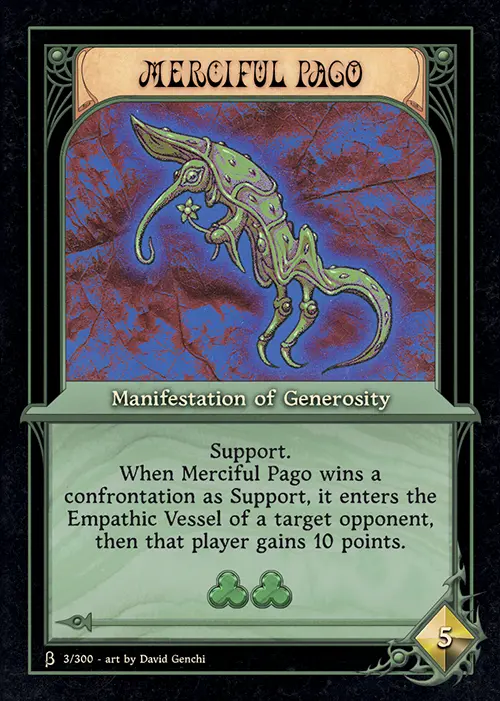
- Card Name
- Manifestation Type
- Effects: The text describing the card's special abilities. Some Manifestations may have the keyword “Support” (3.1). Normally, only one manifestation can be played in the Confrontation, the First Manifestation; only manifestations with Support can be played and enter the Confrontation after it.
- Temperament and Power: The symbols at the base of the card. Their shape and color define its temperament, and their number defines its base power. Essential for winning Confrontations and playing your Wills.
- Points: The value of the Manifestation when it is placed in an Empathic Vessel (1.3). Also used in deck construction; each Cartomancer has a maximum limit of points their deck can contain.
Wills
“Pure intent, acts of determination that a Cartomancer projects onto the Cartomantic Field to alter its balance.”
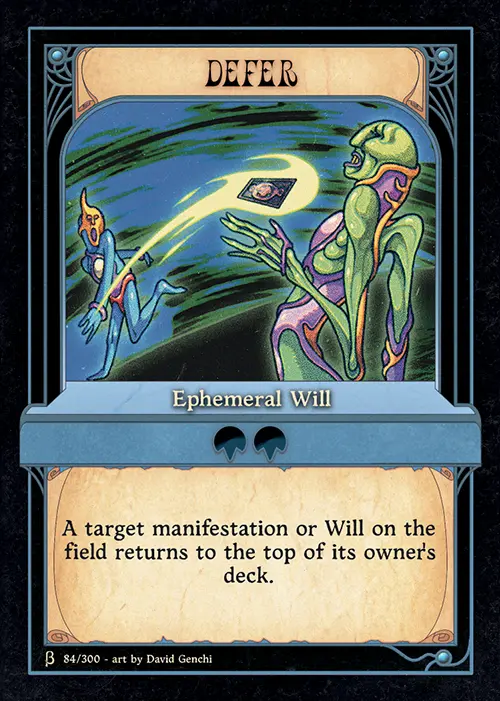
- Card Name
- Will Type
- Ephemeral: A card with an instantaneous effect. It is played, its effect resolves, and then it is placed in the Limbo (1.3).
- Persistent: Unlike Ephemeral ones, it remains in play on the Cartomantic Field (1.3), applying its effect continuously or according to specified conditions. These cards cannot be played in response while other cards are on the stack (2.3) and are only played during the End Phase.
- Tribute Cost: Most Wills require a tribute to be played. The symbols present and their number indicate the Temperament and amount of power to be paid as a tribute. How to pay Tributes will be explained later (2.1).
- Effects: Text describing the Will's effects.
1.3Game Zones
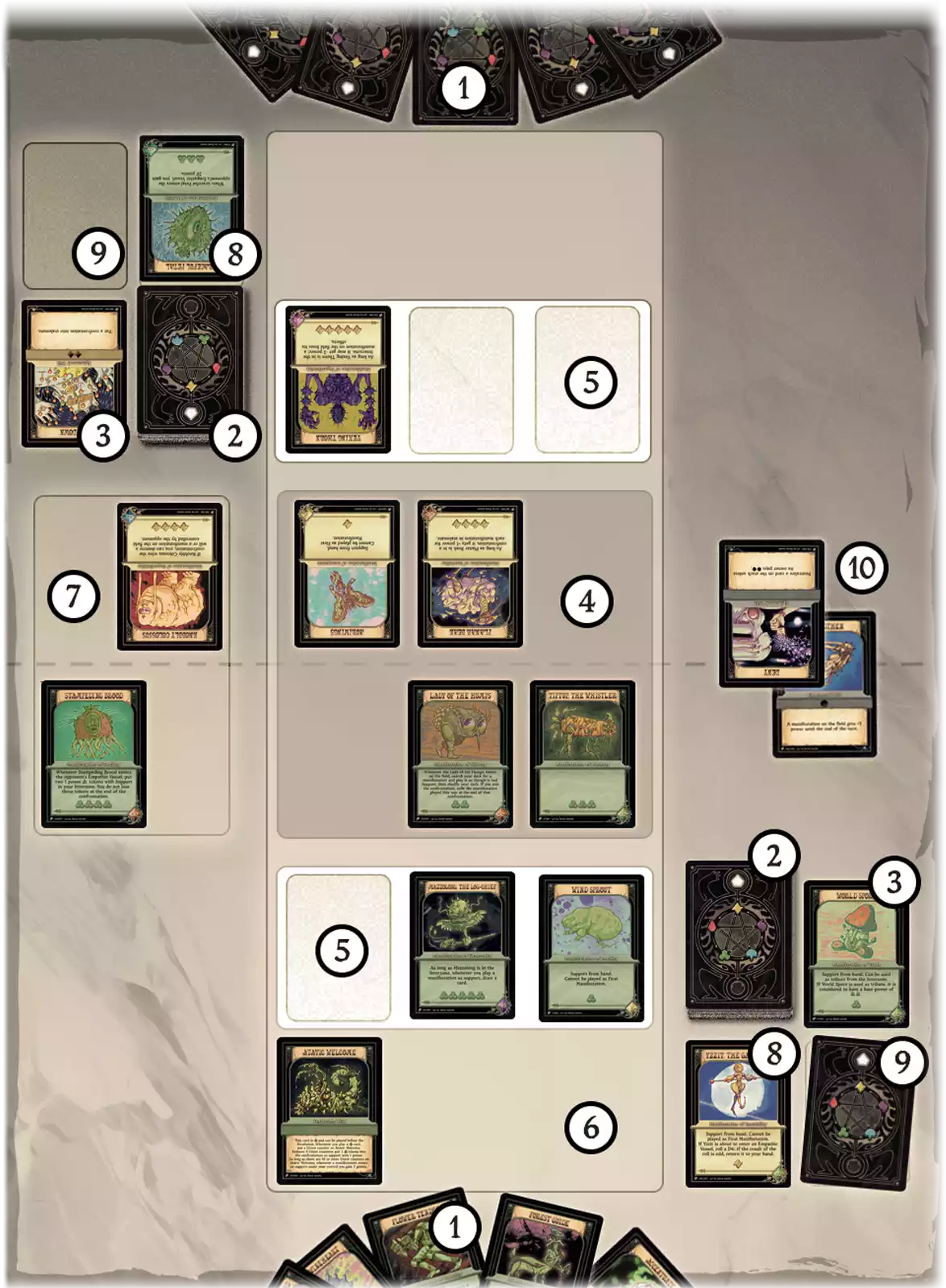
- Hand: The cards the player has available to be played. Hidden from opponents.
- Deck: The remaining cards of your deck, face-down.
- Limbo: The zone where played and resolved Ephemeral Wills, Manifestations used as Tributes, and destroyed cards are placed. Cards are face-up.
- Confrontation Zone: A shared zone where all manifestations played as a First Manifestation or in Support during a Confrontation are placed.
- Interzone: Zone where a player can place up to 3 of their Manifestations that have won a Confrontation to continue utilizing their effects. Cards are face-up. These Manifestations can be replaced by putting them at the bottom of the owner's Deck whenever another one would enter.
- Cartomantic Field: Game zone, often shortened to "field," which comprises the Interzone and the Confrontation Zone, and includes played Persistent Wills, which can be placed at the player's discretion.
- Stalemate Zone: A special zone where Manifestations involved in a Confrontation that ended in a tie (Stalemate) are placed, or moved here by cards or effects. Manifestations remain here until a Confrontation concludes with a winner.
- Empathic Vessel: The zone where the opponent's Manifestations that have lost a Confrontation are accumulated. The points on these cards are counted at the end of the game to determine the winner. Cards are face-up.
- Exile: The zone where all exiled cards are placed, with which it is no longer possible to interact for the rest of the match. Cards are face-down.
- The Stack: A temporary zone where all cards played and effects triggered or activated are placed before they resolve or enter the field, governed by the Stack System (2.3).
1.4Turn Overview
Players compete in shared turns, which are divided into these phases:
- Recovery Phase:
Players draw cards from their deck until they have 7 cards in hand. - Confrontation Phase:
- Players choose and simultaneously play a First Manifestation from their hand, revealing it in the Confrontation Zone.
- After the Revelation, players can play Ephemeral Wills and Manifestations with Support or activate effects of cards on the field (played Persistent Wills, Manifestations in the Confrontation Zone, or in the Interzone).
- Resolution Phase:
- The Confrontation is resolved based on the Power and the Temperament of the Manifestations in the Confrontation.
- If a player wins the Confrontation, they place the opponent's Manifestations into their Empathic Vessel and decide whether to move their own Manifestations to the bottom of their deck or into their Interzone. In case of a tie, all manifestations in the Confrontation Zone are moved to the Stalemate Zone.
- End Phase:
Players can play Persistent Wills.
The game ends when a player has no more cards to draw during the Recovery Phase, or can no longer play a First Manifestation. The player who has accumulated the most points in their Empathic Vessel wins. The various turn phases and permitted actions will be explored in more detail in the "Turn Structure and Phases" section (4.2).
2Playing your Cards
2.1How to Pay a Tribute
“Every intentional act demands a sacrifice. To channel its power, desire is not enough: you must offer a fragment of your own soul of equal intensity in return. This is a Tribute.“
While playing the First Manifestation or put manifestations in Support normally has no cost, many actions (playing Wills, activating effects) require a Tribute to be performed. To pay a Tribute:
- Declare the Will or effect for which you are paying the Tribute and any of its targets (3.2 - Targets).
- Choose one or more Manifestations from your hand of the Tribute's Temperament to reach a total power equal to or greater than the required Tribute value. Show your selection to the opponent.
- Satisfy any additional requirements requested by the action and move the manifestations chosen for the Tribute to the Limbo.
Excess Essence
If the base power of the manifestations used as a Tribute is higher than that required, the excess is considered "Excess Essence." This excess can be used to pay for, or contribute to paying for, other Tributes of the same Temperament, acting as a temporary reserve. If you have Excess Essence, it must always be used for the payment of any Tribute that corresponds to its Temperament. Any Excess Essence not used by the end of the turn in which it was generated is lost.
Special Tributes and Essences
Hollow Tributes (): Many Wills and effects may require a tribute of Hollow temperament . This can be paid using a Manifestation of any Temperament.
Hollow () and Transcendent () Essences: A Hollow manifestation can only pay for Hollow tributes. Conversely, a manifestation or excess essence of Transcendent Temperament can be used to pay a Tribute of any Temperament by declaring, for each essence used, which base temperament it represents.
2.1.1Example of a Tribute
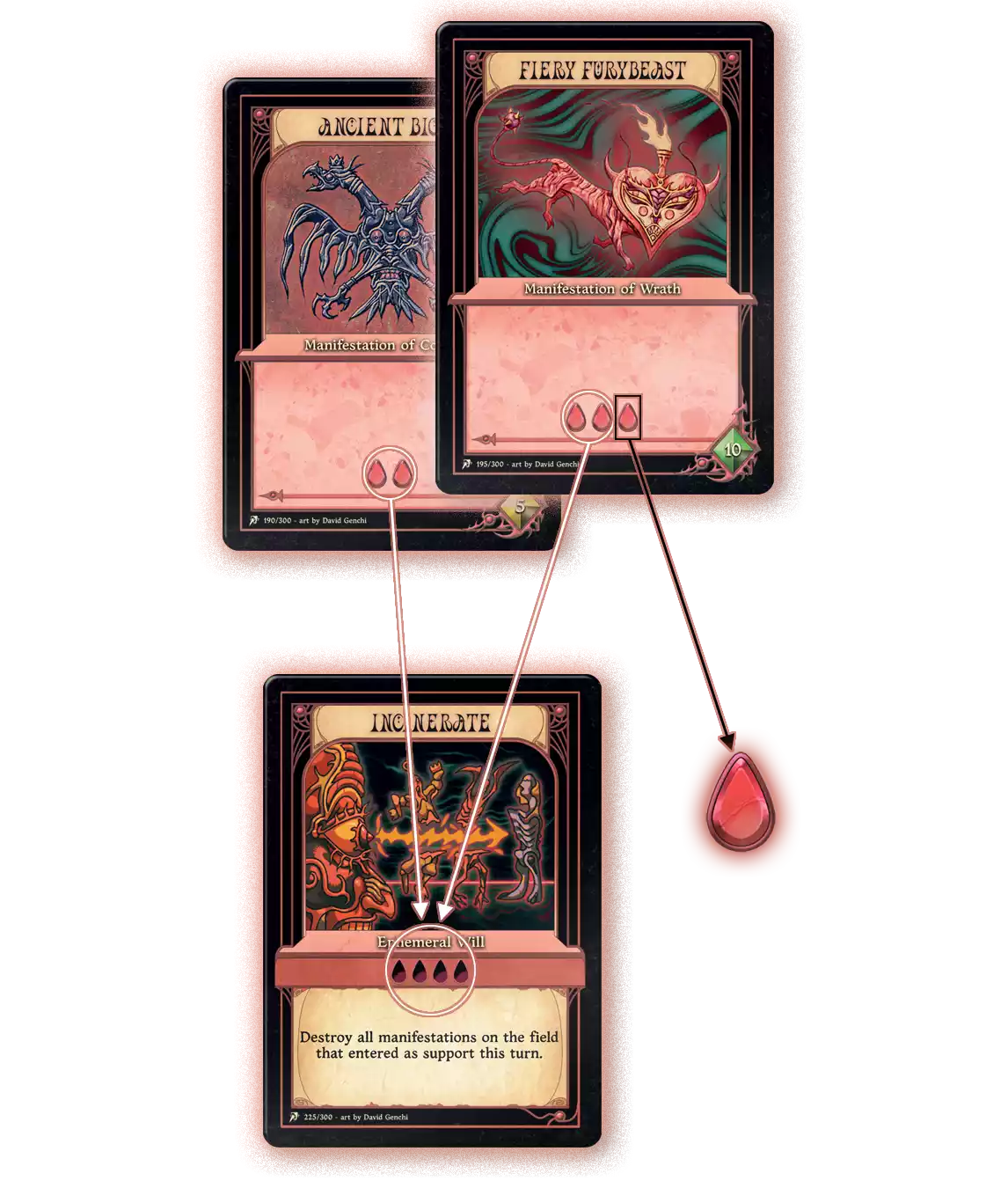
- A player wants to play an Ephemeral Will, "Incinerate," with a cost of 4 (Choleric) Tributes.
- In their hand, they have two manifestations: one with 2 base power and another with 3. Neither is sufficient on its own, so the player uses both, adding their base power together.
- The player shows these manifestations to the opponent and declares they are using them as a tribute for the "Incinerate" Will.
- The Will is played, and the manifestations used as Tribute are placed in the Limbo.
- Having paid for a Will with a cost of 4 with a total power of 5, the player gains 1 Excess Essence, which they can use until the end of that turn.
2.2Priority
Now that you know how to pay tributes and play Wills, you must understand when you have the right to perform these actions. Since Kartomantik is a shared-turn game, it relies on Priority to decide which player is allowed to act.
Who has Priority
- During the Confrontation Phase, the player who would lose the Confrontation if it were resolved at that moment (4.2.3 - Resolution) has Priority.
- In every other game phase, the player who won the last resolved Confrontation has Priority.
Having Priority means having the right to perform an action, such as playing a card or activating an effect. The player with Priority can choose to perform an action or to "pass," giving up Priority to the opponent.
2.3The Stack System
When, having Priority, you play a card or a card's effect is triggered or activated, these actions do not resolve immediately, they are placed on the Stack, a shared zone where they accumulate while waiting to resolve according to the following steps:
- A player puts an action onto the Stack (plays a card, activates its effect, or an effect they control is triggered).
- Priority passes to the opponent, who can respond by putting an action on top of the Stack, or pass. As long as there are actions on the Stack, players exchange Priority automatically each time they add an action to the top of the Stack or pass.
- When both players pass consecutively without adding actions to the Stack, it begins to resolve. Actions on the Stack resolve one at a time in reverse order, starting from the last one added to the Stack (the one on top).
- Each time an action on top of the Stack is resolved and another action is still present on the Stack, every player can interrupt the resolution of the Stack, returning to point 2. Specifically, Priority passes to the player who does not control the action currently on top of the Stack, who can again decide to respond or pass, and so on.
The process continues until all actions on the Stack have been resolved. After the Stack has emptied, players return to applying the normal rules of Priority and can start a new Stack if they still have actions to perform.
- A Card: When you play a card from your hand or from zones other than the field (an Ephemeral Will, a Persistent Will, or a Manifestation with Support), it is the card itself that is placed on the Stack. It waits there for its resolution. If the action resolves, the card produces its effect and then moves to the appropriate zone (Limbo for Ephemeral Wills, Cartomantic Field for Persistent Wills, and the Confrontation Zone for support manifestations).
- An Effect: When you activate an effect of a card that is already on the field (e.g., a Manifestation in the Interzone or a Persistent Will), it is only the effect that is placed on the Stack. The card that generated it remains where it is.
2.3.1Examples of the Stack System
Case 1
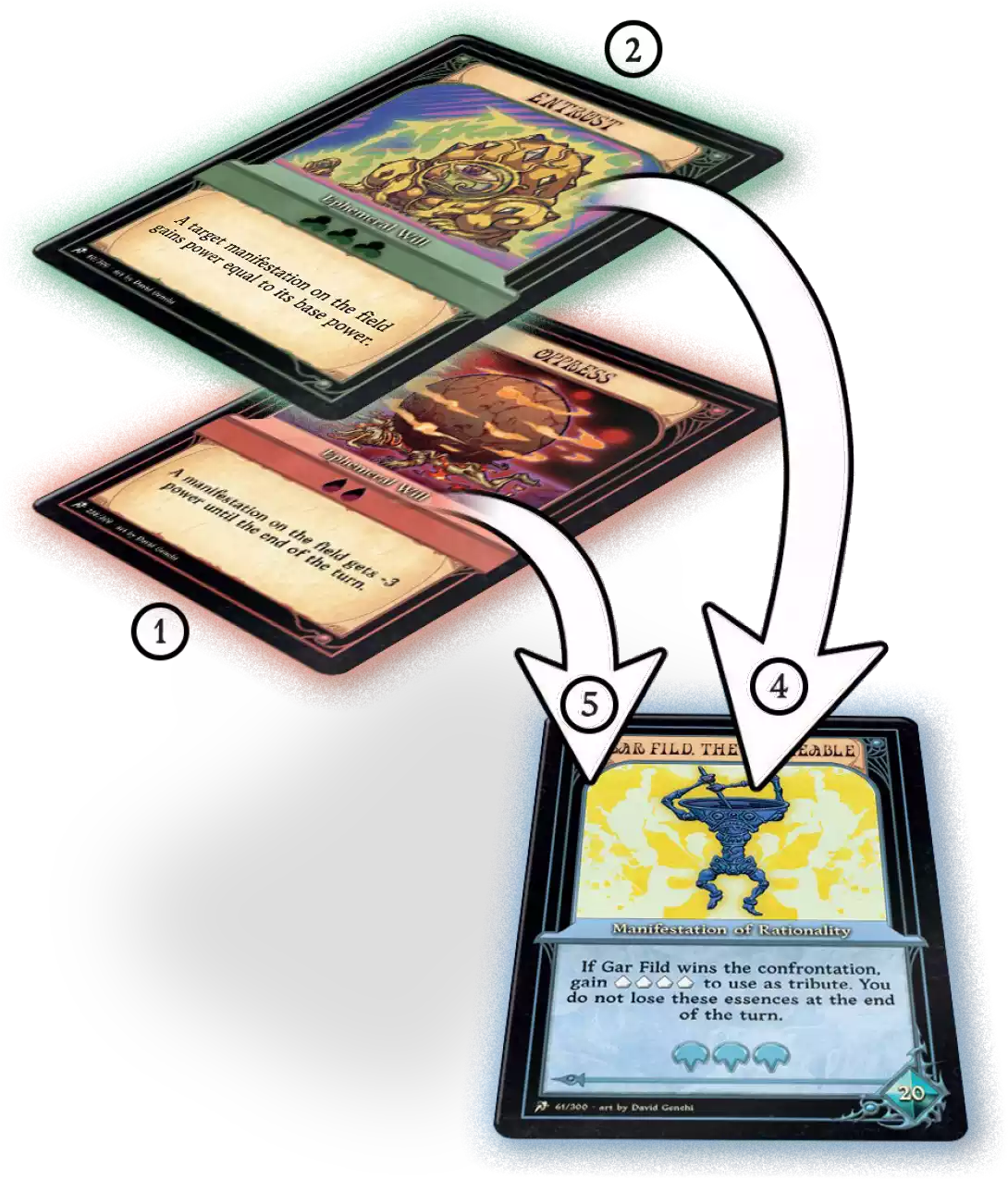
Let's imagine a situation during a Confrontation. Player A has Priority and wants to weaken Player B's "Gar Fild, the Malleable" (3 power) to win the Confrontation.
- Player A plays an Ephemeral Will, "Oppress," targeting "Gar Fild." The effect of Oppress is: "A target manifestation on the field gets -3 power until the end of the turn." The card is placed on the Stack.
- Priority passes to Player B, who responds by playing "Entrust" on their "Gar Fild." The effect of Entrust is: "A target manifestation on the field gains power equal to its base power." The card is placed on the Stack, on top of "Oppress."
- Both players choose not to take any more actions, passing Priority. Since they have passed consecutively, the Stack begins to resolve from top to bottom.
- First, the last action added resolves: "Entrust." The power of "Gar Fild" is doubled, bringing its total power to 6. The Will goes to the Limbo.
- Next, "Oppress" resolves. Its effect is applied to "Gar Fild," which now has 6 Power. Its power is reduced by 3, bringing it to 3. This is not enough to destroy it. "Oppress" also goes to the Limbo.
The Stack is now empty. "Gar Fild, the Malleable" has survived the interaction, and the Confrontation continues.
Case 2
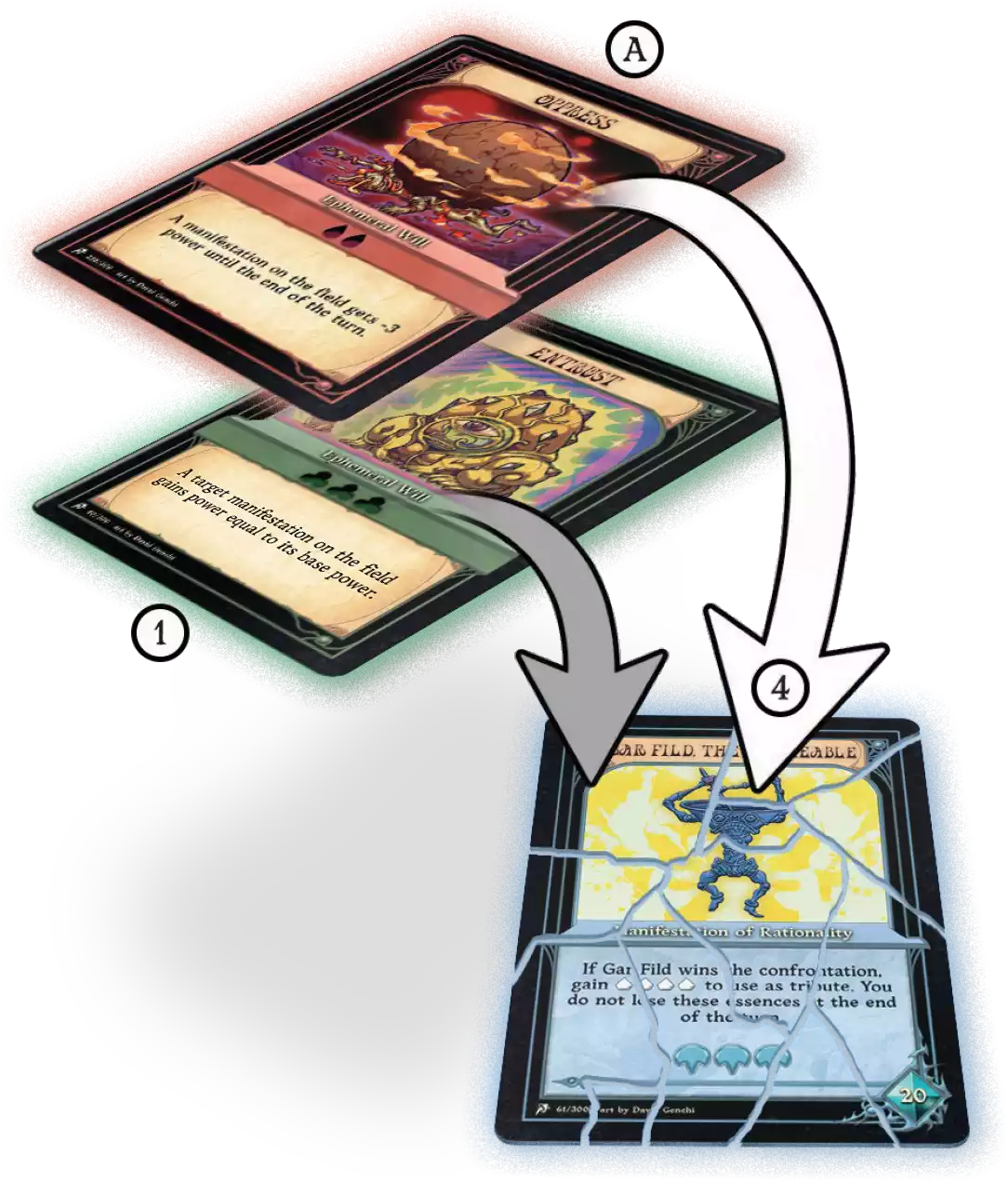
Now, let's see what happens if Player B were at a disadvantage and acted first:
- Player B, having Priority because they are at a disadvantage, plays "Entrust" on "Gar Fild." The card is placed on the Stack.
- Priority passes to Player A, who plays "Oppress" on the same "Gar Fild" in response. "Oppress" is placed on the Stack, on top of "Entrust."
- Both players pass, and the Stack begins to resolve.
- This time, "Oppress" resolves first. It applies its effect to "Gar Fild," which still has 3 Power. Its power drops to 0 (3-3=0), and it is destroyed.
- Next, "Entrust" attempts to resolve. When it tries to resolve, its target, "Gar Fild," is no longer on the field. The effect cannot be applied, and the card goes to the Limbo without having done anything.
3Understanding the Cards
To master Kartomantik, it is crucial to understand how to interpret and apply card effects. The following section serves as a comprehensive guide to these interactions. For a new player, an initial read-through to familiarize yourself with the general concepts is recommended, without the need to memorize every specific rule.
Use this chapter as a rules glossary to resolve specific doubts as they arise.
3.1Types of Effects
Activated
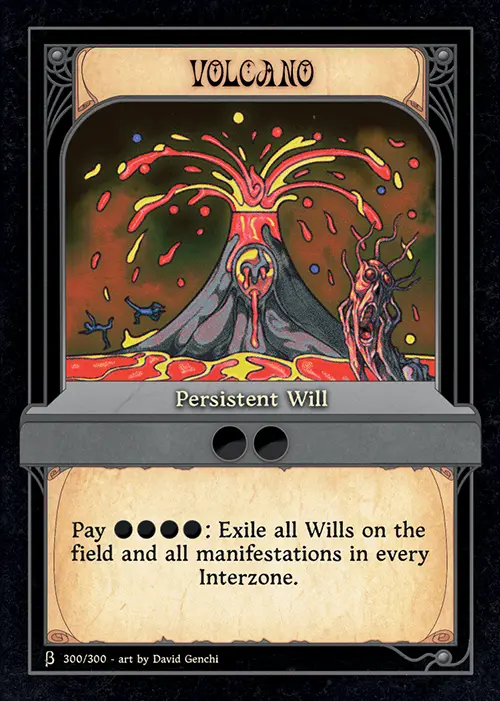
Effects that you can choose to use by paying a Tribute or meeting a condition. You can recognize them by phrases like "Pay [cost]:". Activated effects use the Stack and can only be used after the Revelation of the First Manifestation.
Passive
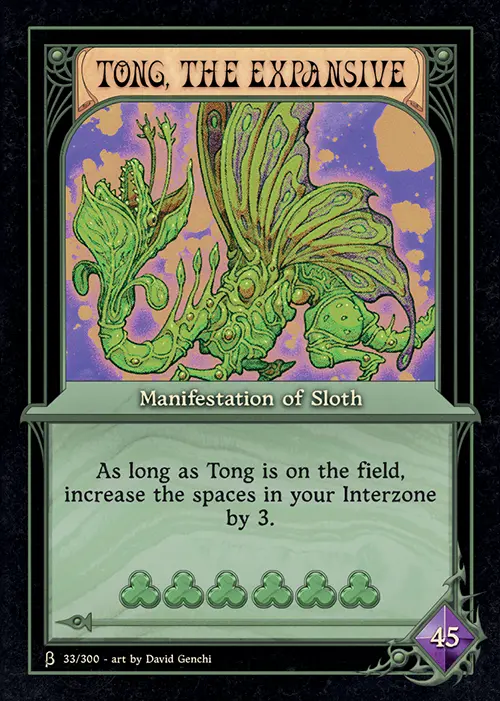
Effects that are always active as long as the card remains on the field (or in the zone they specify). They do not have, nor do they require, conditions to be used. You can recognize them by phrases like "As long as...". They do not use the Stack.
Triggered
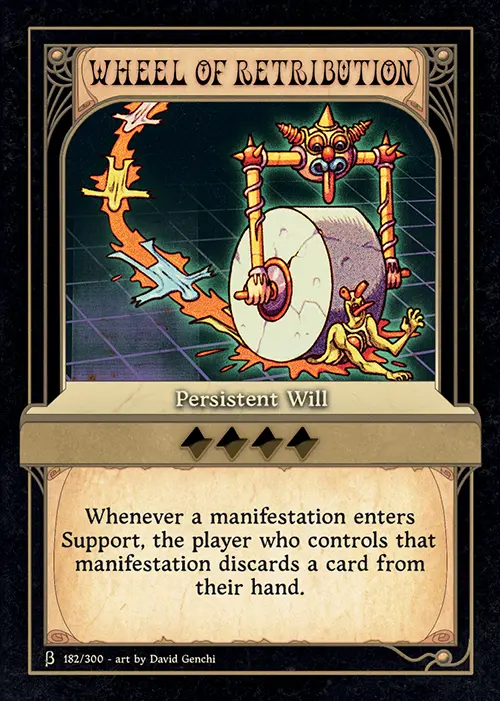
Effects that activate automatically when a specific condition is met. You can recognize them by words like "When...", "Whenever...", "If...". They are placed on the Stack as soon as their condition is met, even during the resolution of the Stack, after the action that triggered them has resolved (players can respond). When multiple cards have a trigger at the same time (e.g., “At Revelation”), those effects are simultaneous. If simultaneous effects are controlled by different players, they are placed on the Stack according to the rules of Priority: the player with Priority puts their effects on the Stack first, then the opponent puts their effects on the Stack.
If multiple simultaneous effects belong to the same player, that player chooses their order on the Stack. In the case of simultaneous effects, all must enter the Stack before it is possible to respond.
Support and Chain
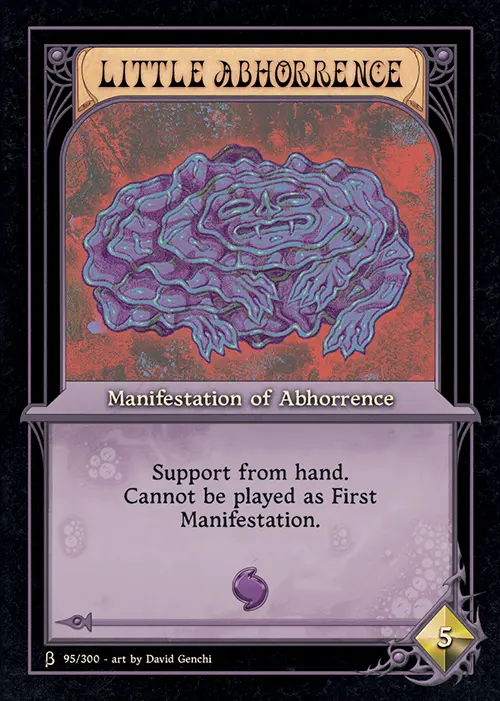
Support is a special activated effect, normally without costs, that allows manifestations to be played and enter the Confrontation Zone after the First Manifestation, from the hand or the Interzone. If "from hand" is specified, that card can only be played in Support from your hand.
Chain is an effect that allows you to put any manifestation into Support from the zone specified on the card. A Chained manifestation is considered "played."
3.2Reading the Effects: Key Rules
The Golden Rule
If the text of a card has an effect that contradicts the game rules, the text of that card takes precedence over the game rules. If effects contradict each other: Absolute restrictions (effects using words like "cannot" or "can only") always take precedence over effects that allow or try to force an action. For example, if one effect says "You cannot draw cards" and another says "Draw 3 cards," the effect that prevents the action always prevails.
Owner and Controller
Each player is always the Owner of the cards they started the game with in their deck and, unless an effect changes it, they are also the Controller, meaning the player who can play them and activate their effects. If a card of which you are the Controller generates an effect, you are also the Controller of that effect. When the text of a card addresses the player directly, for example with "you" or "your," it always refers to the current Controller of the card.
Game Zones
If an effect indicates a zone (e.g., "put in the Interzone") without specifying the owner, it always means the one belonging to the card's controller. Each player is the Owner of all their non-shared game zones: Interzone, Limbo, Deck, Hand, Empathic Vessel, and Exile. The Limbo, the Deck, the Hand, and Exile can contain only cards of which you are the Owner. The Empathic Vessel, conversely, can only contain cards (manifestations) of which you are NOT the Owner. NOTE: Manifestations in Empathic Vessels are always under the control of their Owner.
When cards enter a shared game zone, such as the Confrontation Zone, the Stack, or the Stalemate Zone, these cards enter under the control of their Owner, unless the cards specify otherwise.
Targets
Many cards, to resolve, need one or more targets, the object upon which they have an effect. Every time the word "target" is used in the text of a card in relation to something (a player, a manifestation, etc.), the controller of that card must declare a valid target before putting that action on the Stack. For example, if an effect says "A target manifestation on the field gets -1 power," that effect requires a target. Its controller must therefore declare a Manifestation on the field as a target before putting the effect on the Stack. The target must be valid both when the effect is put on the Stack and when it resolves. If the target is no longer valid when the effect resolves (if, for example, the manifestation has been removed from the field), the effect does not take place.
Action Validity
You cannot play a card or activate an effect if you cannot fulfill all of its requirements. This includes paying Tributes, additional costs (e.g., discarding cards), and choosing a sufficient number of valid targets.
Modifiers and Counters
Anything that alters the base characteristics of a card or a zone, whether in permanent or temporary form, is called a Modifier. If a manifestation's power increases or decreases, or if a card loses its effects or gains others beyond those it would normally have, these are Modifiers.
Modifiers are, unless otherwise indicated, permanent, but only as long as the card remains on the Cartomantic Field or in the Stalemate Zone. This means that, for example, a manifestation with Modifiers can move between the field (Interzone, Confrontation Zone) and the Stalemate Zone without losing its modifiers; however, if it leaves one of these zones to enter a Limbo, an Empathic Vessel, a deck, the hand, or Exile, the manifestation loses all its Modifiers.
Counters are instead a resource that must be placed on a card; each Counter has a specific name and is useless on its own, but can be used to satisfy the requirements of cards that need them to activate certain effects. Counters follow the same rules as Modifiers.
Power vs Base Power
Base Power is a generally stable value, indicated by the number of symbols present on a manifestation. In addition to indicating its starting power, it also indicates the value of that manifestation when used as a Tribute.
Power is a variable value determined by the sum of the Base Power and all the modifiers affecting it in a temporary or permanent way. Furthermore, Power is the value calculated to determine the result of a confrontation.
Independence of Effects
An activated or triggered effect, once put on the Stack, exists independently of its source. If the card that generated the effect is removed from the game while the effect is still on the Stack, the effect will still resolve. An effect that triggers when a card undergoes a certain event (such as being destroyed) triggers at the instant that event occurs. That effect will go onto the Stack even if the card that generated it is leaving the game.
“Memory” of Effects
Sometimes, a card's effect doesn't just resolve, but it creates a new rule or a delayed effect that "attaches" to another card. This new rule remains valid even if the original source of the effect leaves the field, as if the target card retains a memory of it. For example, if you play a Will that says: "Chain from your hand. If the Chained manifestation wins the confrontation, exile it." Even if the original Will is now in the Limbo, the rule to exile is "remembered" by the manifestation. At the end of the Confrontation, that manifestation will be exiled.
Play and Move
Cards have multiple ways to enter the field; the most common consists of playing them. A card is normally "played" when it is Revealed as a First Manifestation, enters the Stack from the hand or deck, or is played from other zones due to an effect. Cards, however, can also enter the field by being moved, which always occur via other cards or effects. If a card, for example, speaks of "putting" something in an area, that's a movement, and the same applies to manifestations that enter in Support. These are considered movements; the cards enter the zones specified by these effects without first passing through the Stack, and therefore are not considered "played" unless the effect explicitly states it (as, for example, with the "Chain" effect).
Actions from the Hand
Whenever a player is asked by a card or effect to perform an action involving their hand, if that player is unable to perform it, they must always prove it by showing their hand to their opponents.
To interpret all the effects of your cards and their keywords, go to the "Keywords" section.
4Playing a Game
Now that you have understood the basic mechanics, it's time to sit down and try the game. Let's go into detail to see how a game of Kartomantik unfolds between two players.
4.1Building a Deck
To start playing, each player must have their own deck.
Each deck must be built according to these rules
- There must be exactly 30 cards.
- The sum of the Points of all Manifestations in the deck must not exceed 500. Will cards do not have a point cost for deck construction.
- There can be no more than one copy of the same card (same name) in the deck.
It is recommended to have between 8 and 12 Wills in a deck, and to ensure that their tributes can all be paid. For multi-temperament decks, it is preferable to add Hollow Wills or manifestations, Transcendent or not, that can pay for multiple temperaments.
If players want to play best-of-3 (Bo3), they can create, in addition to a normal deck, a Sideboard of 6 cards with no point limits. Before the start of each match, each player can modify their deck by replacing cards in it with any card chosen from their Sideboard, respecting the normal construction limits.
4.2Turn Structure and Phases
After the players have chosen and thoroughly shuffled their decks, the game begins with the first turn, starting directly with the first Recovery Phase.
It is recommended to have counters and small objects to use as tokens for your card effects.
4.2.1Recovery Phase
- If it is not the first turn, resolve any "at the beginning of the turn" effects and restore all your exhausted cards.
- Each player draws cards from their deck until they reach the hand limit of 7 cards. If a player's hand has already reached the limit, that player does not draw.
- Each player checks if they have at least one Manifestation card in hand that can be played as a First Manifestation, otherwise they must perform a Mulligan. All manifestations, unless specified otherwise, can be played as a First Manifestation.
- After checking for the First Manifestation, resolve or play any effects that can occur "upon the end of Recovery."
The Mulligan
If a player has no manifestations playable as a First Manifestation, they must declare it, show their hand to the opponent to confirm, shuffle all cards from their hand back into their Deck, and draw again up to the hand limit. This is a "Mulligan." The Mulligan is allowed at the first turn, only once, even in case you have a valid Manifestation in your hand. In that case, lose 10 points.
4.2.2Confrontation Phase
The Confrontation is composed of two sub-phases: Revelation and Reaction.
Revelation
- Both players must secretly choose a Manifestation card from their hand to play as their First Manifestation for the turn. The chosen card is set apart from the hand (e.g., kept face-down on the table or simply clearly identified) to show that the choice has been made.
- Afterwards, each player resolves or plays any effects and cards that can occur "before the Revelation".
- Simultaneously, the players uncover their chosen First Manifestation and place it on their side of the Confrontation Zone.
- All Immediate effects on Revelation are triggered.
- Then, "when it enters the field" or "when it enters the Confrontation Zone" effects of the First Manifestations and any manifestations played due to their effects are triggered.
Reaction
- All "after the Revelation" effects are triggered.
- From now on, players can:
- Play Ephemeral Wills from their hand (paying any Tributes).
- Play Manifestations with Support from their hand or Interzone to add them to the Confrontation.
- Use activated effects of Persistent Wills or Manifestations already on the field.
All these actions follow the rules of Priority and the Stack. The Confrontation phase continues until the Stack is empty and both players decide to pass.
4.2.3Resolution Phase
Once both players have passed during the Reaction part of the phase:
Each player sums the current Power (base power plus any modifiers) of all their Manifestations in the Confrontation Zone. If a player has no manifestations in the Confrontation, their total power is considered 0. When one player has greater total power, that player wins the Confrontation.
When a Player Wins
- Any on-win, on-loss, or "at the Resolution" effects are triggered.
Players can play Wills from their hand and use activated effects until both players pass consecutively, before cards are moved to their respective zones. Those effects do not alter the outcome of the Confrontation. - The winning player places all Manifestations owned by the opponent present in the Confrontation Area and in the Stalemate Zone into their Empathic Vessel.
- For each Manifestation they are the owner of present in the Confrontation Area or in the Stalemate Zone, they can decide, in any order, to:
- Place it at the bottom of their Deck, face-down.
- Place it in a space in their Interzone. If that space was already occupied by another Manifestation, that manifestation is placed at the bottom of its owner's Deck, face-down.
In case of a tie in power
The natural dominance of the Temperaments is used. Compare the Temperament of the last manifestation that entered the Confrontation under each player's control. If one player has the dominant Temperament, they win the Confrontation.
The hierarchy is as follows:
- Phlegmatic beats Vitreous and Capricious.
- Vitreous beats Melancholic and Choleric.
- Melancholic beats Capricious and Phlegmatic.
- Capricious beats Choleric and Vitreous.
- Choleric beats Phlegmatic and Melancholic.
- Transcendent beats any other Temperament.
- Hollow is beaten by any other Temperament.
If the total power in the Confrontation and the Temperament of the last manifestations played are both equal, the Confrontation ends in a Stalemate.
You can use the card’s back as reference.
Stalemate
In the event of a tie, all Manifestations of both players currently in the Confrontation Zone leave the field and are moved to the Stalemate Zone. They remain there until a Confrontation is won, retaining all their permanent modifiers.
4.2.4End Phase
When the Confrontation has been resolved and the Manifestations have been moved to their respective zones, players can play Ephemeral Wills and Persistent Wills from their hand, or use activated effects, with Priority going to the player who won the last resolved Confrontation.
Each time during the End Phase a Stack initiated by a player resolves completely, priority passes to their opponent.
Once the Stack is empty and both players pass consecutively
- Resolve any "at the end of the turn" effects.
- All "until the end of the turn" effects wear off.
The turn ends. If a player ended the turn with more than seven cards in hand, they place the excess cards at the bottom of their deck in any order.
A new turn begins from the recovery phase until one of the two End Game Conditions (4.4.1) is met.
4.3Summary of Phases and Permitted Actions
4.4End of the Game and Point Calculation
4.4.1End Game Conditions
The game ends IMMEDIATELY if one of the following conditions is met:
- A player, during the Recovery Phase, could not draw enough cards to reach the required hand limit.
- A player, during the Recovery Phase, after their second consecutive Mulligan, still does not have a playable First Manifestation in hand. In this case, the player loses the match.
4.4.2Point Calculation
Once the match has ended
- Each player sums the values in Points of all Manifestation cards present in their Empathic Vessel at the end of the match and the Points gained or lost from card effects.
- If a player still has Manifestation cards in their deck, they obtain 5 bonus Points for each Manifestation card remaining inside it.
4.4.3Win Condition
The player with the highest total of Points wins the match. In case of a tie in Points, the match is a draw.